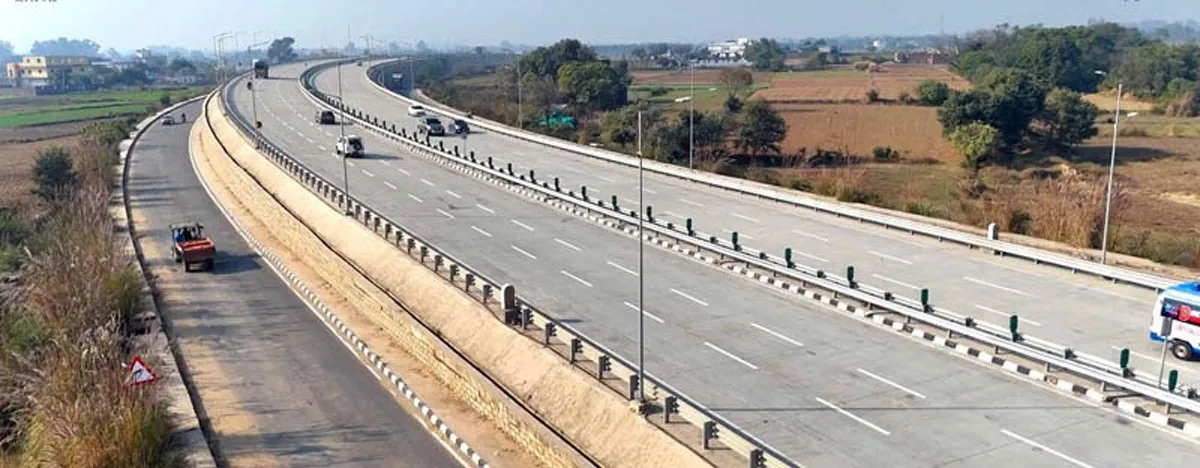
“Many residents claimed that they were informed only after decisions had already been taken”
K Koushal
Marketed as symbols of modern connectivity and economic progress, the Jammu and Srinagar Ring Road projects have come under increasing scrutiny as environmentalists, affected residents, and legal experts question the ecological and social cost of the ambitious infrastructure drive.
Official records and environmental assessments reveal that the construction of the two ring roads between 2018 and 2025 has resulted in the felling of more than 1.18 lakh trees, large-scale acquisition of agricultural land, and significant disruption to fragile ecosystems and rural livelihoods across Jammu and Kashmir.
“The 62-kilometre Srinagar Ring Road alone has witnessed the removal of nearly 1.10 lakh trees, including fruit-bearing apple, walnut, pear, plum, mulberry and culturally significant chinar trees,” suggests the records shared by environmentalists, adding that the uthorities have also proposed the felling of more than 1,200 additional trees to facilitate pending construction works.
Meanwhile, the 58.25-kilometre Jammu Ring Road has led to the removal of thousands of trees, with over 8,000 reportedly cut and permissions granted for the removal of thousands more.
“These projects have become emblematic of a development model that prioritises speed and concrete over sustainability,” they said.
The scale of forest and vegetation loss has alarmed conservationists. Between 2021 and 2023, Jammu and Kashmir recorded the loss of more than 40 square kilometres of forest cover, with infrastructure projects emerging as a major contributing factor.
“Particularly troubling is the impact on the Valley’s iconic chinar trees. Once numbering around 42,000 in the 1970s, their population has declined to nearly 32,500,” said environmentalists, adding that more than 1,400 chinar trees have reportedly been felled over the past decade, raising concerns about the survival of one of Kashmir’s most cherished environmental and cultural symbols.
Anuj Kumar Environmentalist from We The Humans Forum for Nature and Mankind warned that mature trees cannot be replaced simply by planting saplings.
“A 50-year-old fruit or chinar tree provides ecological services that thousands of saplings may take decades to match,” said a local environmental researcher.
The destruction of tree cover comes at a time when Jammu and Kashmir is already experiencing visible climate stress. Scientific studies point to a rise of nearly 2 degrees Celsius in maximum temperatures over recent decades, while rainfall patterns have become increasingly erratic.
The year 2024 recorded a rainfall deficit of nearly 29 percent, intensifying concerns over groundwater depletion, soil erosion and declining agricultural productivity.
Experts fear that continued deforestation associated with road expansion could further weaken the region’s ability to withstand extreme weather events.
“The environmental cost is not merely the loss of trees. It is the loss of climate resilience, carbon storage, biodiversity and natural protection against floods and heatwaves,” said experts.
Beyond environmental damage, the projects have had serious socioeconomic consequences. Hundreds of acres of agricultural land have been acquired for the two ring roads, affecting orchard owners and farming families whose livelihoods depend on fruit cultivation.
Thousands of fruit-bearing trees were uprooted during construction. This is particularly significant in a region where the apple industry supports nearly 3.5 million people directly and indirectly.
Many affected landowners have alleged that compensation was calculated using outdated rates that fail to reflect current market values. Several farmers claim that compensation packages were based on valuation norms dating back decades, leaving them unable to replace lost assets or restore their livelihoods.
“We did not lose land alone; we lost generations of income,” said an orchard owner whose family land fell within the project alignment.
The projects have also sparked legal controversies. Environmental groups have accused authorities of inadequate compliance with environmental safeguards and have pointed to instances where courts and regulatory bodies intervened over alleged irregularities in tree felling and land acquisition procedures.
Critics argued development projects of such magnitude should undergo rigorous environmental scrutiny and public consultation before implementation. Instead, many residents claimed that they were informed only after decisions had already been taken.
Perhaps the most serious criticism concerns the failure to implement effective mitigation measures.
Despite the massive scale of tree removal, environmental groups alleged that compensatory afforestation remains largely incomplete. Unlike cities such as Delhi, where tree transplantation policies seek to preserve mature trees wherever possible, no significant tree-transplantation programme was undertaken for the ring road projects.
Officials have proposed avenue plantations along certain stretches, but experts aargued that such measures are grossly inadequate when compared to the ecological value of the mature forests and orchards that have been destroyed.
Few dispute the need for improved transportation infrastructure in Jammu and Kashmir. However, critics insinsisted that development cannot be measured solely in kilometres of asphalt and reduced travel times.